Thelma Kalama Aiu: Exploring Mana and Mana Wahine Theory
by Liv Deeley
“Mana is enhanced by the collective in order to support people's role in fulfilling particular obligations, social and political functions, as such it is a significant contributing factor to how we present ourselves and are seen by others” (Pihama 354).
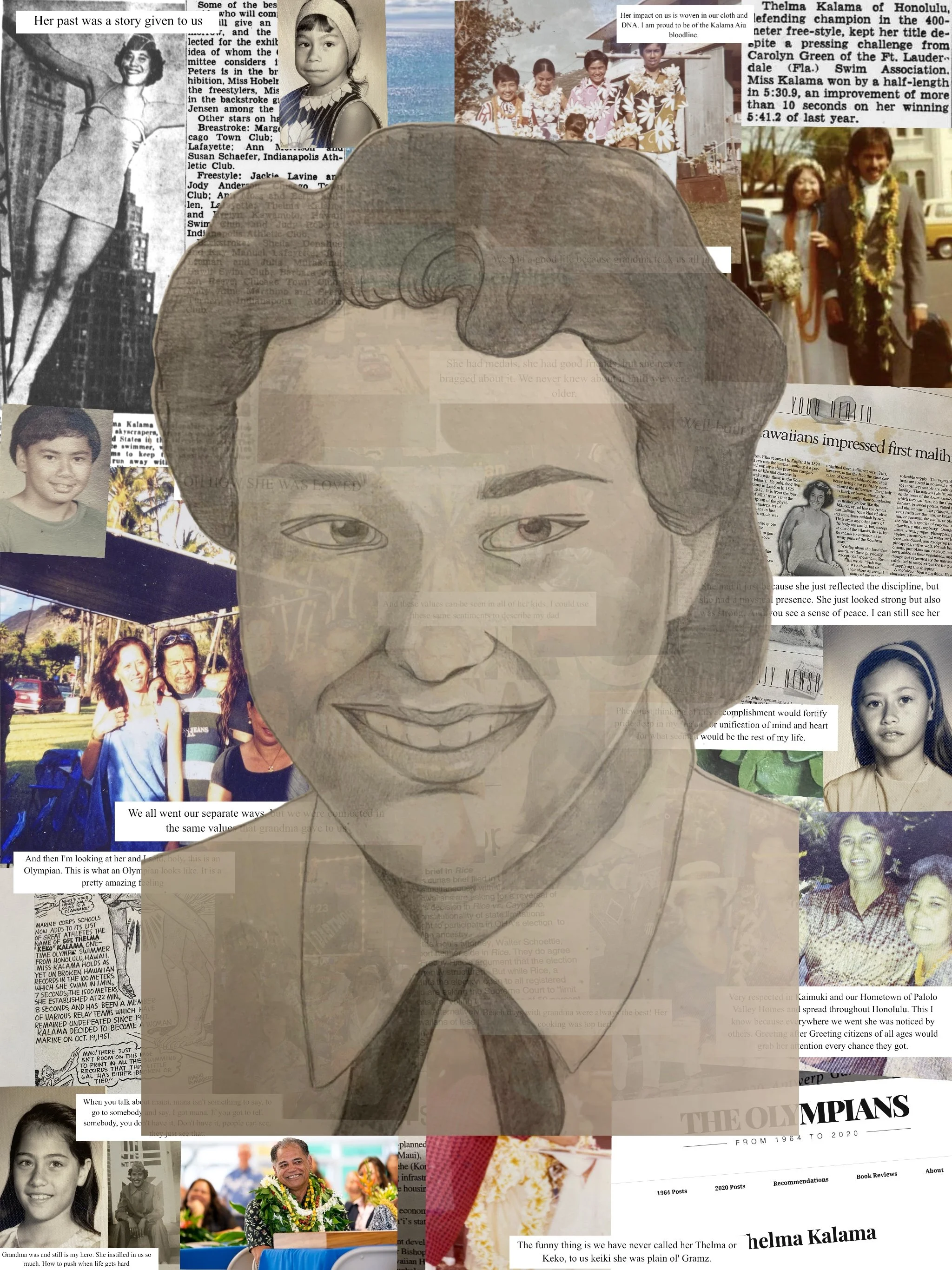
Mana is a word often misunderstood. Many non-Hawaiians view mana as an obsolete aspect of an ancient Hawaiian religion. Some only understand it as the Hawaiian translation of “power.” However, the word is crucial to Hawaiian political history and relevant to activist movements in the Pacific today. In this essay, I track the use of mana as a keyword through history and then focus on one of its modern day uses within mana wahine theory. Mana wahine encapsulates Kanaka Maoli women’s power and activism through hardship. To explicate the concept, I observe a case study of my great-grandmother Thelma Kalama Aiu. Thelma won a gold medal for swimming in the 1948 Olympics and then returned home to raise seven children by herself. Her impact is still felt within my family and throughout multiple O‘ahu communities. The study culminates in a visual art piece that exemplifies both mana and mana wahine theory.
Mana originally denoted the spiritual power that Kanaka Maoli and particularly ali‘i (rulers or chiefs) inherited from the gods. All things are imbued with some level of mana because all things–both inanimate and living–are descended from divinity. However, one can possess more mana with increased responsibility among the web of beings. That is, the more they have to care for the more “powerful” they become. One’s mana diminishes if they fail to bear that responsibility. Haunani-Kay Trask explains that “far from being tyrants as the West would have, our ali‘i were stewards who cared for the people…they had to care for the people and abide by kapu laws otherwise they lost their mana.” (Trask, 00:42). In her essay “Mana Hawai‘i” Noenoe K. Silva highlights the difference between mana and Western notions of power through the example of God. She states that for the Christian missionary, God’s power “exists regardless of whether or not anyone believes in him; we understand him as powerful because he created the heavens and earth.” However, mana suggests that God’s power comes from “a variety of sentient beings [that] listen to him when he speaks” (Silva 40). Deities only have power because others interact with them. In a pre-settler context then, mana was mostly used in association with the power given to ali’i through the gods and earth-bound beings.
In the 19th century the word began appearing in the Hawaiian Kingdom’s government constitutions. Samuel Kamakau, a Hawaiian historian of the time, noted that “only in Hawai’i did a king willingly implement a constitution” (quoted in Silva 45). Hawaiian rulers practiced benevolence because they realized mana came from the wellbeing of the people and the land. Thus, the difference between power and mana (in a historical and political sense) is that instead of a ruler exerting power on a people, the people give power to the ruler.
Today, the word mana appears in other contexts regarding Hawaiian culture and wellbeing. “Mana wahine” is a phrase used to describe Hawaiian women’s importance in political activism and in the home. It is based on the idea that mana comes from ancestral connections and responsibility for others. This process is gendered as women are often responsible for rearing future generations. Hawaiian scholar Ku’ualoha Ho’omanawanui writes “Kanaka Maoli women’s bodies are instrumental in the continuity of the lāhui (the people), birthing, nurturing and raising the next generations…our bloodlines are interwoven stories and histories of our people that connect us back to our gods and land, and through our children, to our collective future” (Ho’omanawanui 172). Women have mana because they often bear responsibility for the community and the next generations. Their responsibility for others gives them more mana. Mana wahine theory in part seeks to dismantle the systematic erasure of women’s importance that exists in our westernized, post-colonial society.
Female leaders are also consistent among historical movements for progress and sovereignty. Leonia Pihama writes that mana wahine theory “affirms the mana that women hold both individually and collectively, irrespective of the ways in which colonial and colonising writers have undermined the position of our female ancestors” (Pihama 359). Historical mana wahine include Kamehameha I’s wife Ka’ahumani, who broke the kapu system by eating at the same table as the king and paved the way for other women to rise into political power. Other names that come to mind are Queen Lili‘oukalani, Bernice Pauahi Bishop, Princess Ruth Ke’elikōlani, and Haunani-Kay Trask. Throughout Hawaiian history, women have remained central to driving political and social movements.
To illustrate mana and specifically mana wahine theory, I observe a case study of my great grandmother Thelma Kalama Aiu which results in a culminating art piece. Thelma was the daughter of a strict Hawaiian father and a German mother. Growing up impoverished and in wartime, swimming became her escape. She woke up early to practice and practiced again at night. In high school, she was granted entry into Soichi Sakamoto’s prestigious Hawai‘i Swim Club. At seventeen years old Thelma represented the United States in the 1948 London Olympics and won a gold medal in the women’s 4x100 freestyle relay. After returning home she joined the military for four years. Although she was both an Olympian and a veteran, Thelma lived on welfare and in Palolo community housing due to the high cost of living in Hawai‘i. She married for a short time to John Aiu who brought with him four children from a previous marriage. After living together for some years and producing three more children, John divorced Thelma and left the house and kids to her. She worked as a convenience store manager and raised all seven children on her own. When some of them later fell short as parents, she helped raise her grandchildren and even officially adopted one of them.
Throughout my many interviews, a recurring theme materialized. Every person noted the way that Thelma carried herself. She was humble and had a “peace” about her. Although she accomplished much at a young age, she did not make it explicitly known. Many of her children did not know she was an Olympic gold medalist until they were much older. Also mentioned frequently was the respect she garnered throughout the communities of Palolo Valley, Kailua, and Honolulu. Her grandson Travis stated, “everywhere we went she was noticed by others…people of all ages would grab her attention every chance they got.” Her actions and aloha were noticed throughout O‘ahu. She bore responsibility with grace. In this way, she exhibits both mana and mana wahine theory. Mana manifests not just through religious or political power but also through the way one woman uplifts herself and others. After her death in 1999, she was inducted into the Hawai‘i Sports Hall of Fame.
I decided that a visual art piece would be most effective in capturing Thelma’s mo’olelo, or story. Ho’omanawanui discusses the close relationship between mana wahine and ki’i (visual art), stating that important themes in Kanaka Maoli women’s art include kinship and remembering ancestors (Ho’omanawanui 149). In addition, Indigenous scholar Michelle Raheja argues that visual art can exist as a form of decolonization. She explains that art can open space for Indigenous ways of life and highlight the “vibrant, lived experiences of Native people” (Raheja 28). Sovereignty and mana are closely related. If visual sovereignty exists then so too does visual mana. Mana should not reside solely in constitutions and historical documents, it must be lived within the individual. It is in the way you carry yourself and the way you interact with others. It is infused with the act of living, and this relationship manifests most clearly in the arts.
I created a collage as the culminating art piece because the medium allows an array of voices to come through as opposed to just my own. In his essay “Three Mana of a Mo’olelo about Translation,” Bryan Kamaoli Kuwada explains that “the Hawaiian word for a version of a story or a retelling of a mo’olelo is ‘mana,’ recognizing that the more a story gets told and retold, the more it gains in mana” (Kuwada 197). Retelling Thelma’s story embodies mana wahine theory and contributes to her personal mana. The collage features images of Thelma but also images of her future generations and of those whose lives she touched. It also includes extracts of interviews and historical newspaper clippings. It assembles the chorus of voices eager to share and keep sharing her mo’olelo. Thelma passed away almost thirty years ago, yet her presence continues to light up the faces of so many people. Her lessons and love reverberate through generations. That is true mana.
Works Cited
Aiu, Lani. Personal interview. 9 February 2025.
Aiu, Travis. Personal Interview. 9 February 2025.
Aiu, Trisha. Personal interview. 7 February 2025.
Deeley, Kahi. Personal Interview. 12 February 2025.
Ho’omanawanui, Ku’ualoha. “The Art of Mo’olelo: Mana Wahine, Aloha ‘Aina, and Social Justice.” Mo’olelo: The Foundation of Hawaiian Knowledge, edited by C.M. Kaliko Baker and Tammy Haili‘ōpua Baker, University of Hawai’i Press, 2023, pp. 147-176.
Kalama, Kamoa. Personal Interview. 10 February 2025.
Kamaoli Kuwada, Bryan. “Three Mana of a Mo’olelo about Translation.” Mo’olelo: The Foundation of Hawaiian Knowledge, edited by C.M. Kaliko Baker and Tammy Haili‘ōpua Baker, University of Hawai’i Press, 2023, pp. 179-203.
Michelle, Raheja. “Visual Sovereignty.” Native Studies Keywords, University of Arizona Press, 2015, pp. 25-34.
Pihama, Leonie. “Mana Wahine: Decolonising Gender in Aotearoa.” Australian Feminist Studies, edited by Lisa Adkins and Maryanna Dever, University of Adelaide, 2020.
Silva, Noenoe. “Mana Hawai’i: An Examination of Political Uses of the Word Mana in Hawaiian.” New Mana: Transformations of a Classic Concept in Pacific Languages and Cultures, edited by Matt Tomlinson and Ty P. Kawika Tengan, ANU Press, 2016, pp. 37-54.
Trask, Hawaiian History: A Hawaiian Perspective. Juniroa Productions, VHS; 1986.